
BEST WILDLIFE PHOTOS 2025
My Best Wildlife Photos of 2025 and the stories behind them
2025 has been an incredible year for me, both creatively and professionally. I’m encouraged by how my work continues to evolve, not only in the pursuit of new and different images, but in creating fine art wildlife photographs that carry strong stories. Central to that ambition is my ongoing search for places where wildlife and landscape exist in true harmony.
This year was bookended by two first-time destinations: Iceland at the beginning of the year and Antarctica at the end. Both left a lasting impression, and I’ve shared those experiences in Photo Stories – Emperor Penguin Photography and Land of Icelandic Horses for anyone who would like to explore what makes these wild places so special.
Alongside new species and locations, it remains important to me to deepen my work with the subjects I’ve photographed for years. In 2025, that meant returning to Amboseli, the Maasai Mara, India, Baffin Island, and Peñalajo, with each rewarding me with images I’m excited to share in this story.
I hope you enjoy part two of this journey through some of the world’s most iconic wildlife and landscapes, and the stories they tell.
Happy New Year—and here’s to a wild and wonderful 2026!
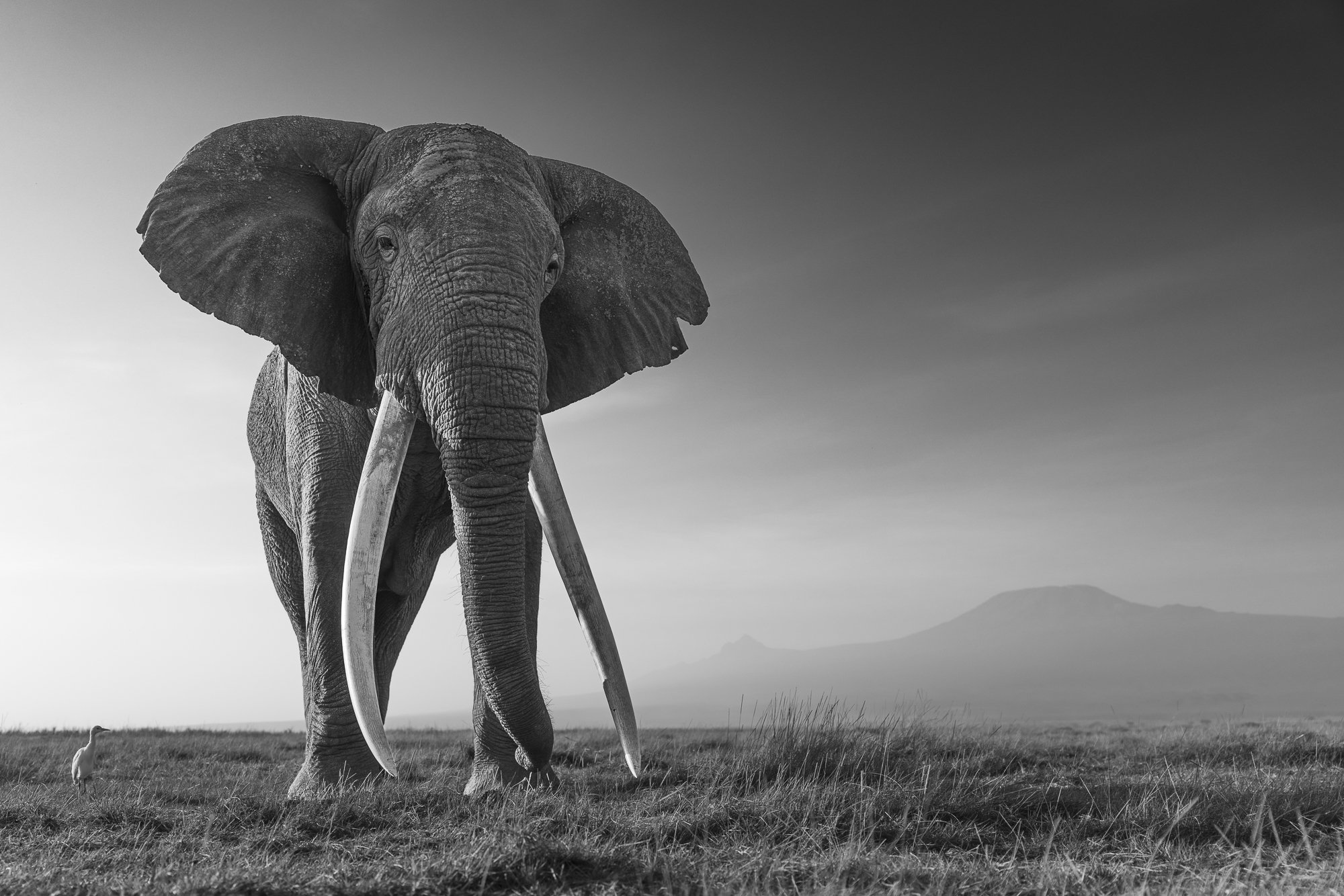
Super Tusker Michael stands in front of Kilimajaro
Two Giants
Sometimes in wildlife everything aligns, and this is one of those moments. It’s an image of Michael, a magnificent super tusker, known for his enormous tusks that almost touch the ground. What is even more extraordinary is that he’s only in his early 30’s so just entering his prime years as a bull elephant, which means he will continue to grow both the size of his tusks and in stature.
The fact that this was my first sighting of Michael after several visits to Amboseli made it even more special and serendipitous. I had heard that Michael was in musth so he was frequenting the park in search of receptive females. That would increase my chances of a sighting of him.
We set off at dawn the next morning and drove towards the Ol Okenya swamp area to see if he was amongst the first groups of elephants moving into that area. My guide Eric spotted him almost immediately amongst a family of elephants, who were moving at a pace, clearly agitated by his presence. The matriarch wasn’t interested & other females were not interested.
After a period of time, he separated from the herd and started grazing, but slowly but surely, he moved in a direction where I could align him with Mount Kilimanjaro and I was able to get an image of two magnificent giants together, emblematic of Amboseli’s iconic wildlife and landscape.
Settings: Canon R5 II, RF24-70mm F2.8, 1/2500, F2.8, ISO 100
Thanks to my guide Eric Ole Kalama and the team at Elephant Garden Camp
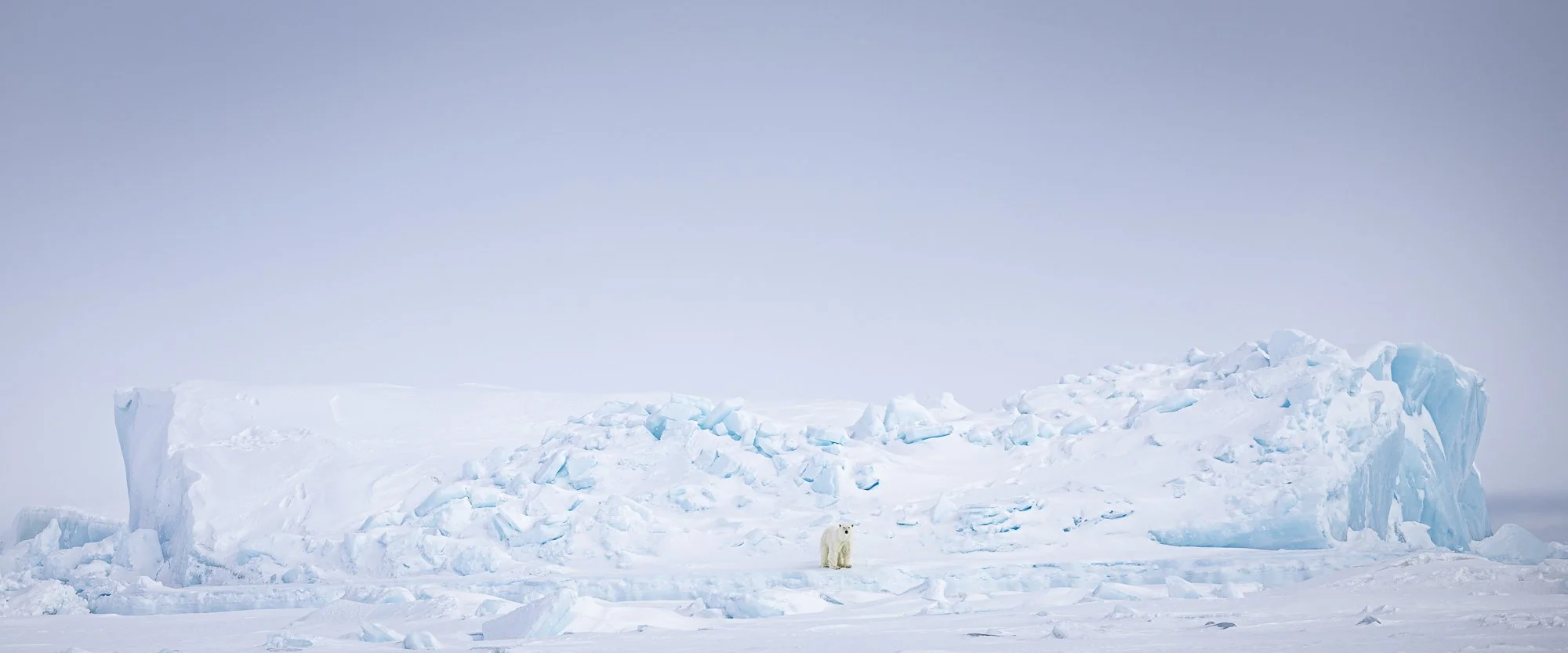
Polar bear standing in front of iceberg
Polar Bear and his ice palace
I returned to Baffin lsland in Canada in March this year in the hope of yet again getting to see Polar Bears. This was my third consecutive year camping on the sea ice in Baffin for the simple reason that it is one of the most majestic & pristine environments in the world to photograph polar bears, especially in March & April when the sea ice has frozen. However, with temperatures between-30 to -40 it is also one of the most challenging to ensure you keep your hands warm to press the shutter
Our spotters went out before breakfast to look for tracks & bears & on this day we were lucky as they spotted this young 4 year-old male bear on an iceberg about 30 minutes from our camp. When we got to the scene the bear was on top of the iceberg & was walking across it as we approached on our skidoos. It was an incredible & exciting sight to behold.
However, before we could get our cameras ready the bear had started to climb down from this incredible winter palace of an iceberg. As he moved to the center & take a closer look at us, rather than pick up my 600mm lens, I grabbed my 70-200 lens as I thought this would more perfectly capture the scene in front of me. It’s also encapsulates why I think Baffin is the best place to see polar bears is the wild.
Settings: Canon R3, RF70-200mm F2.8, 1/2500, F2.8, ISO 100
Thanks to my guide Paul Goldstein & the incredible team at Arctic Kingdom
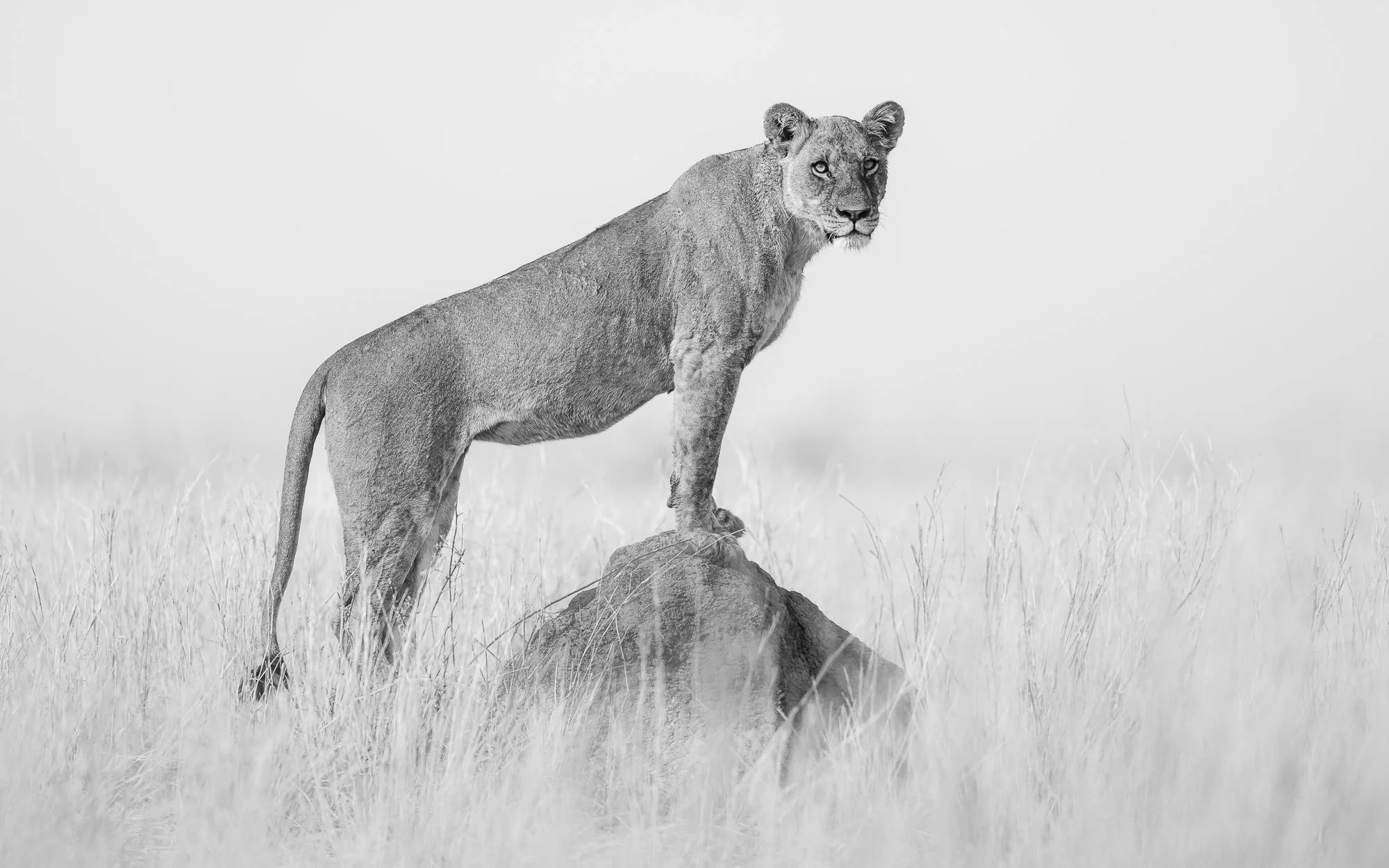
Lioness standing on termite mound
Lion Queen
Sometimes restraint reveals more than spectacle. This portrait centers on a lioness in her prime looking alert, composed, and wholly present in her mission to find her prey.
We encountered the Chobe Pride in the early morning as they searched for Cape buffalo. When this lioness climbed a termite mound to survey the plains, she became elevated against the open horizon free of all distracting elements. By working low, hanging out of the window, with my 400mm lens as low to the ground as I could reach I was able to isolate her form, allowing her posture and gaze to carry the weight of the image.
Originally I captured the image in color, but the muted blue sky and drought-worn grass offered little beyond a contrasting distraction. By converting to black and white I was able to bring out the texture and contrast in the lioness. The result is less about the hunt and more about the presence of a powerful predator.
Settings: Canon R5 II, EF 400mm F2.8 III, 1/1250, F2.8, ISO 1250
Thanks to Russell MacLaughlin, shot on location in Mokete, Botswana
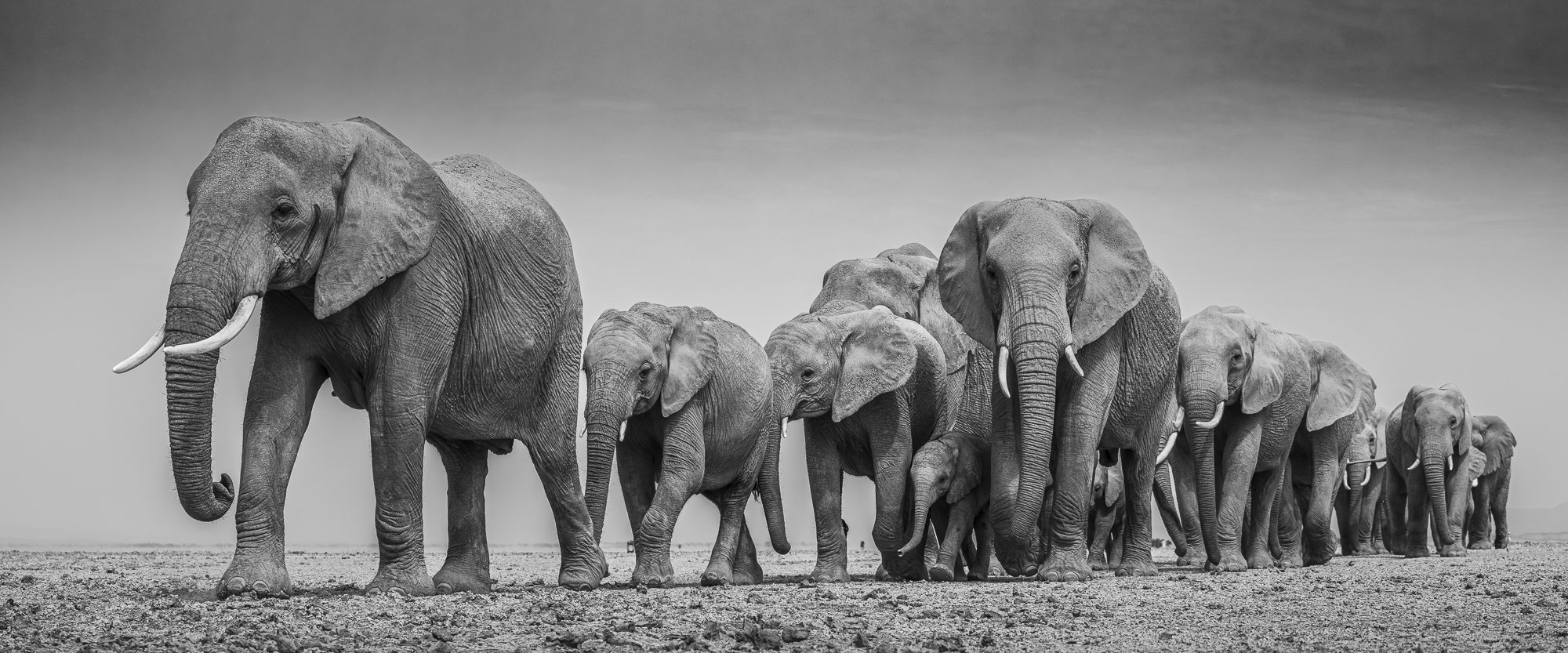
A matriarch leads her elephant family across the Amboseli lakebed
Leading the Way
I had landed in Amboseli at 8am and within 30 minutes was heading to the famed lakebed with my guide Eric. I couldn’t believe our luck as we could see a family of about 20 elephants start to make the journey across the lakebed towards the swamp area.
As they moved closer, we moved into position. Some of the elephants split off to the right so I focused my attention on the matriarch leading her family on the left. Part of my reasoning was also because this group had two baby elephants and I hoped at some point they would be visible within the group. Of the sequence of images, I liked this the most as one of the babies reveals itself, whilst still protected by other adult elephants in the family.
Settings: Canon R5 II, RF70-200mm F2.8, 1/800, F9, ISO 1000
Thanks to my guide Eric Ole Kalama and the team at Elephant Garden Camp
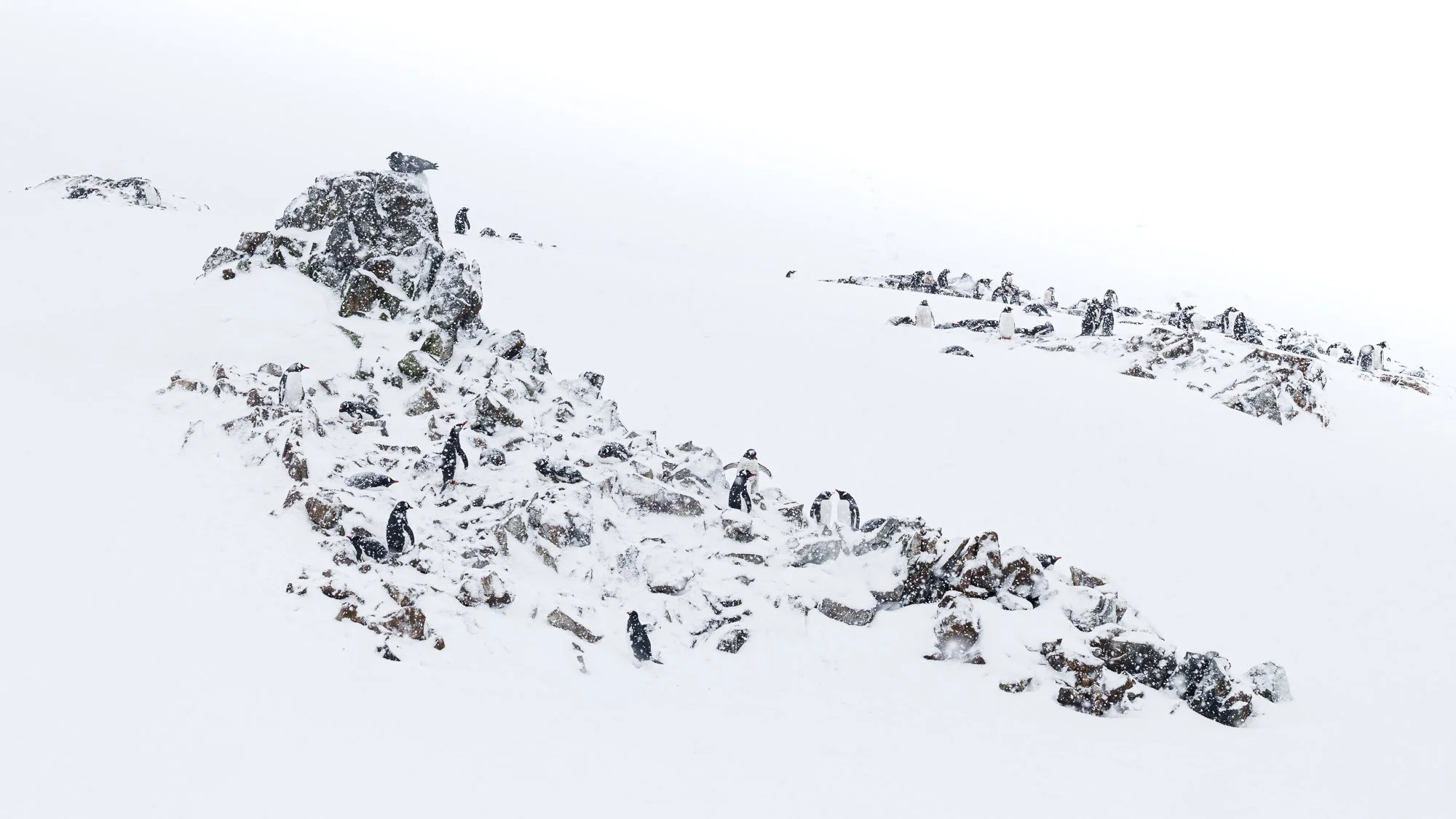
Gentoos in Snow storm
Gentoos in Winter Landscape
We landed on Petermann Island during a snowstorm with conditions that transformed the Gentoo penguin colony into something extraordinary. From one of the island’s higher rocky outcrops, I watched the colony in constant motion with Gentoo pairs mating, stones being exchanged and nests taking shape. In the falling snow, patience became essential to look for scenes and moments that captured life in the colony.
When I noticed an Antarctic skua perched above the colony, the scene came together. The elevated vantage point, the movement below, and the driving snow spoke to the severity of the environment these birds endure. I stopped down to preserve detail across the frame, allowing the penguins’ comings and goings to remain visible despite the storm.
After reviewing the image it reminded me of the artwork by Dutch master Pieter Bruegel’s who pioneered painting panoramic winter landscapes, where life persists amid hardship. Take a look at his Hunters in the Snow painted in 1565.
Even in the harshest conditions, the colony never stands still.
Settings: Canon R5 II, RF100-300mm F2.8 + 1.4 EXT, 1/800, F13, ISO 2000
Thanks to the incredible team at Quark Expeditions
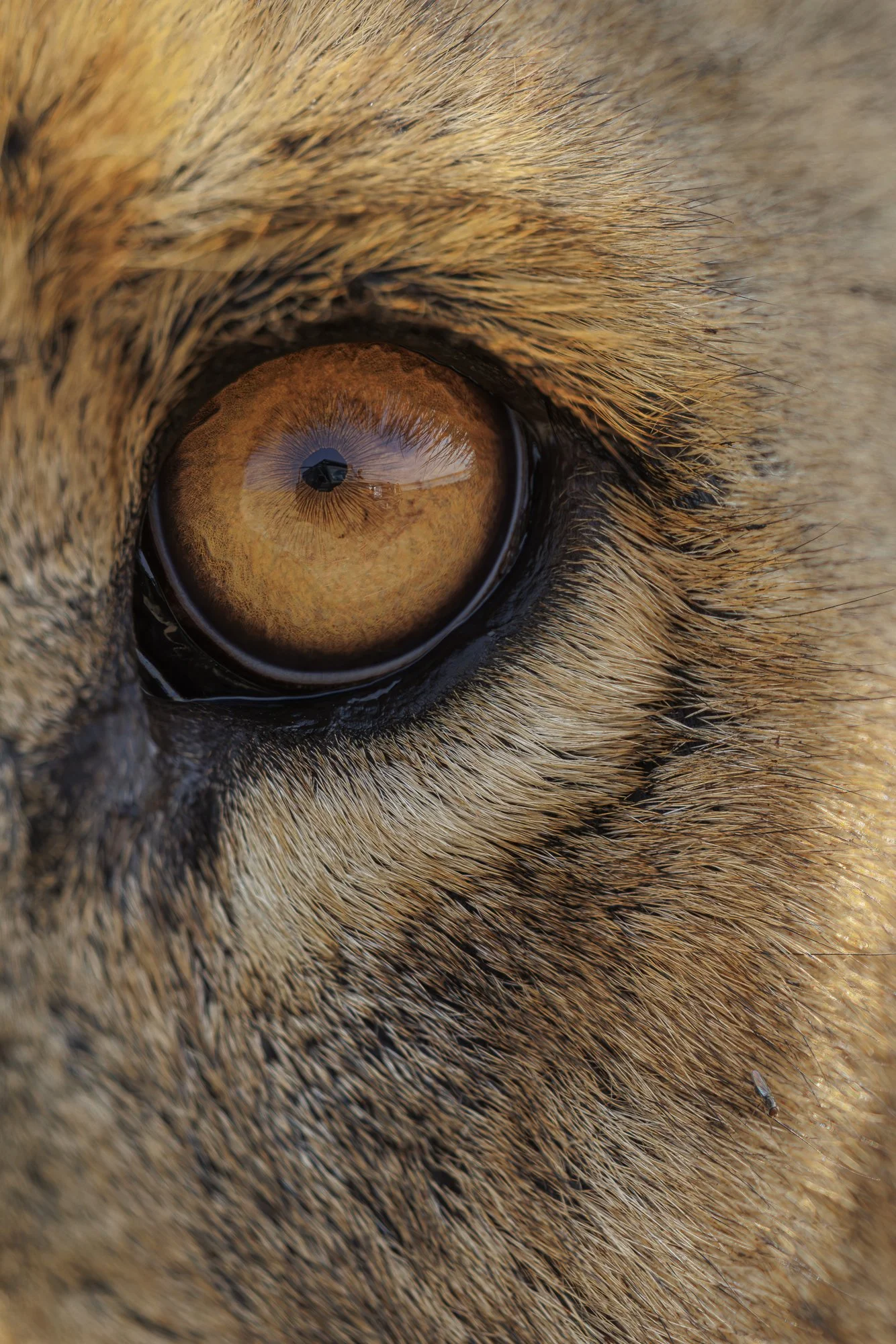
Close up image of a Lion’s eye
Eye Contact
One of the male lions from the Mokete Pride was resting at the side of a waterhole. When he stood up and started yawning, I knew he was going to start to make a move. As the light was quite harsh and the terrain was muddy and messy I decided that I was going to try and get some full frame portraits of the lion and attached my 2x extender to my 400 F2.8 lens.
I was hand holding my camera & lens as the lion moved towards our vehicle, and I focused on capturing the details of the lion’s frame as it came closer. As it came closer, I switched to portrait mode and when I couldn’t get the whole of the lions face in the frame, decided to focus on his right eye. As the plane of focus was still narrow, getting the eye pin sharp wasn’t easy, but in this image, details revealed themselves as you see the stunning patterns in the lion’s eye.
Settings: Canon R5 II, EF 400mm F2.8 III +2x EXT, 1/1250, F5.6, ISO 1000
Thanks to Russell MacLaughlin shot on location in Mokete
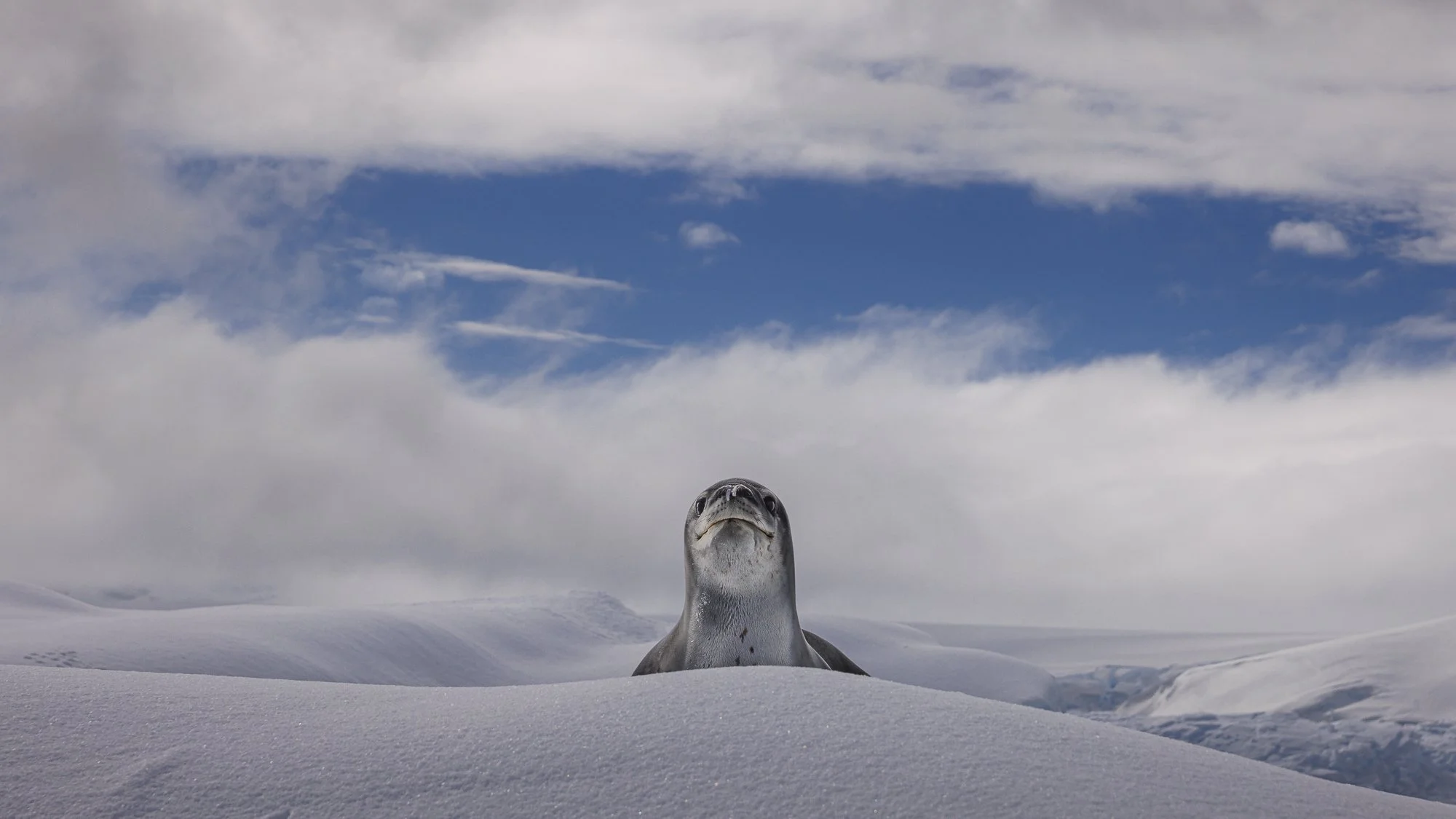
Leopard Seal pops its head up whilst resting on iceberg
The Smiling Assassin
During a zodiac cruise amongst icebergs, we spotted a leopard seal sleeping on the ice. As we moved round the iceberg looking for the best angles to shoot from, he woke up and became more curious. After taking some tighter portraits, I decided to use a wide-angle lens to capture the seal in its pristine environment. Most images of leopard seals capture them as the sinister assassins of the seas that they undoubtedly are. So, I like that this image of the leopard seal is more unexpected and original as the seal looks more like a friendly curious turtle as it popped it popped his head above the ice to get a closer look at us.
Settings: Canon R5, RF24-70mm F2.8, 1/2500, F8, ISO 125
Thanks to the team at Quark Expeditions
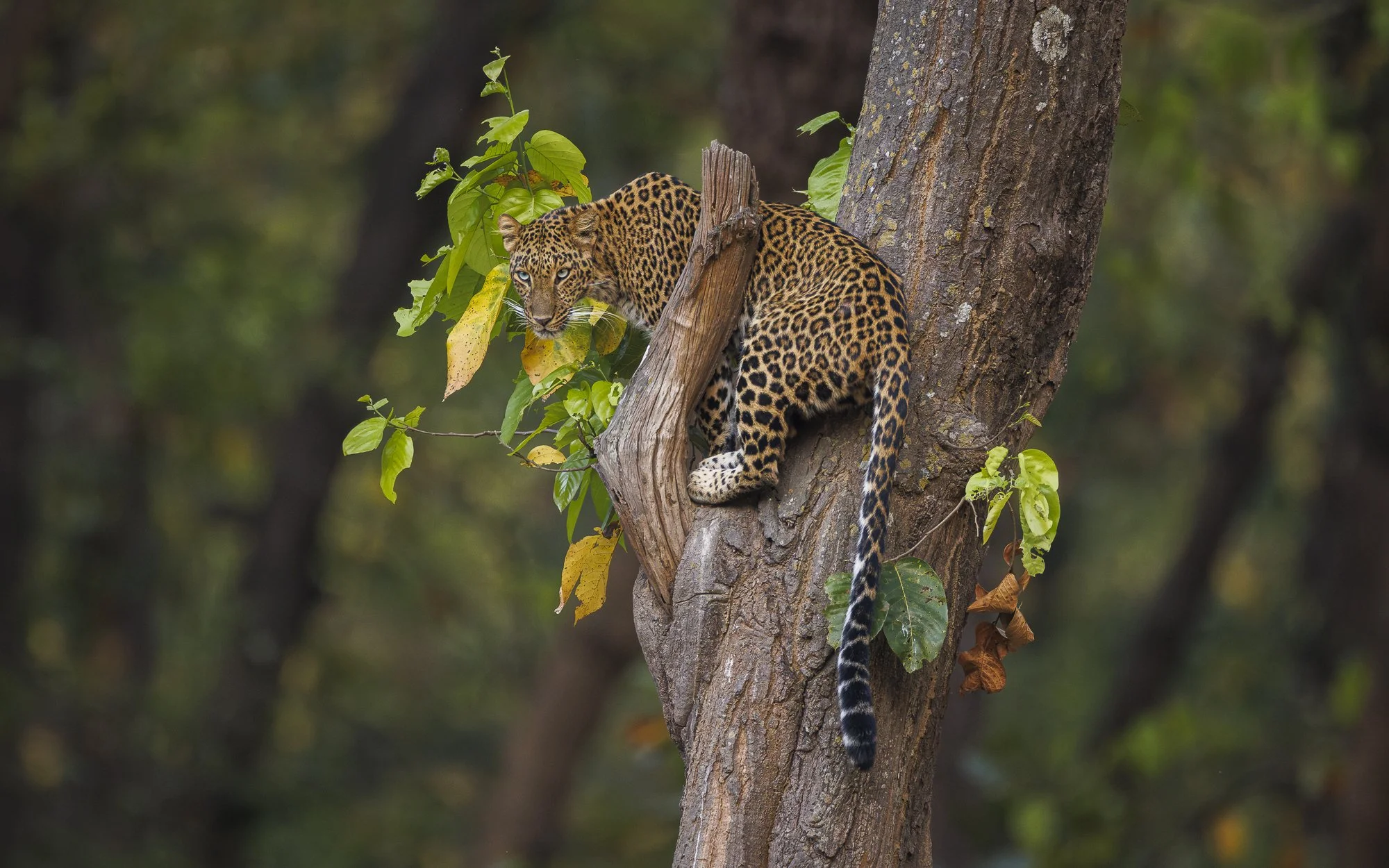
Leopardess stalks her prey from tree canopy
Poised for a Kill
This was an unforgettable finale to my time in Rajaji spent with this beautiful blue eyed leopard called Maya.
She hadn't been spotted for four days, we presumed because she had a kill somewhere. On our final morning we briefly spotted her on the move, scent marking as she went.
On our afternoon game drive we made it our mission to find her. We repeatedly checked waterholes and after checking one of her favorites for the third time, there she was sitting between the trunks of two trees. She stayed in that position until she saw some Sambar & Cheetal deer approaching.
She then stealthily climbed up a nearby tree & was completely focused & poised to make her attack as the deer moved closer to the waterhole. Unfortunately for her they didn't
Settings: Canon R5, EF 400 F2.8 III +1.4 EXT, 1/640, F4, ISO 3200
Thanks to my guide Mithun Hunugund
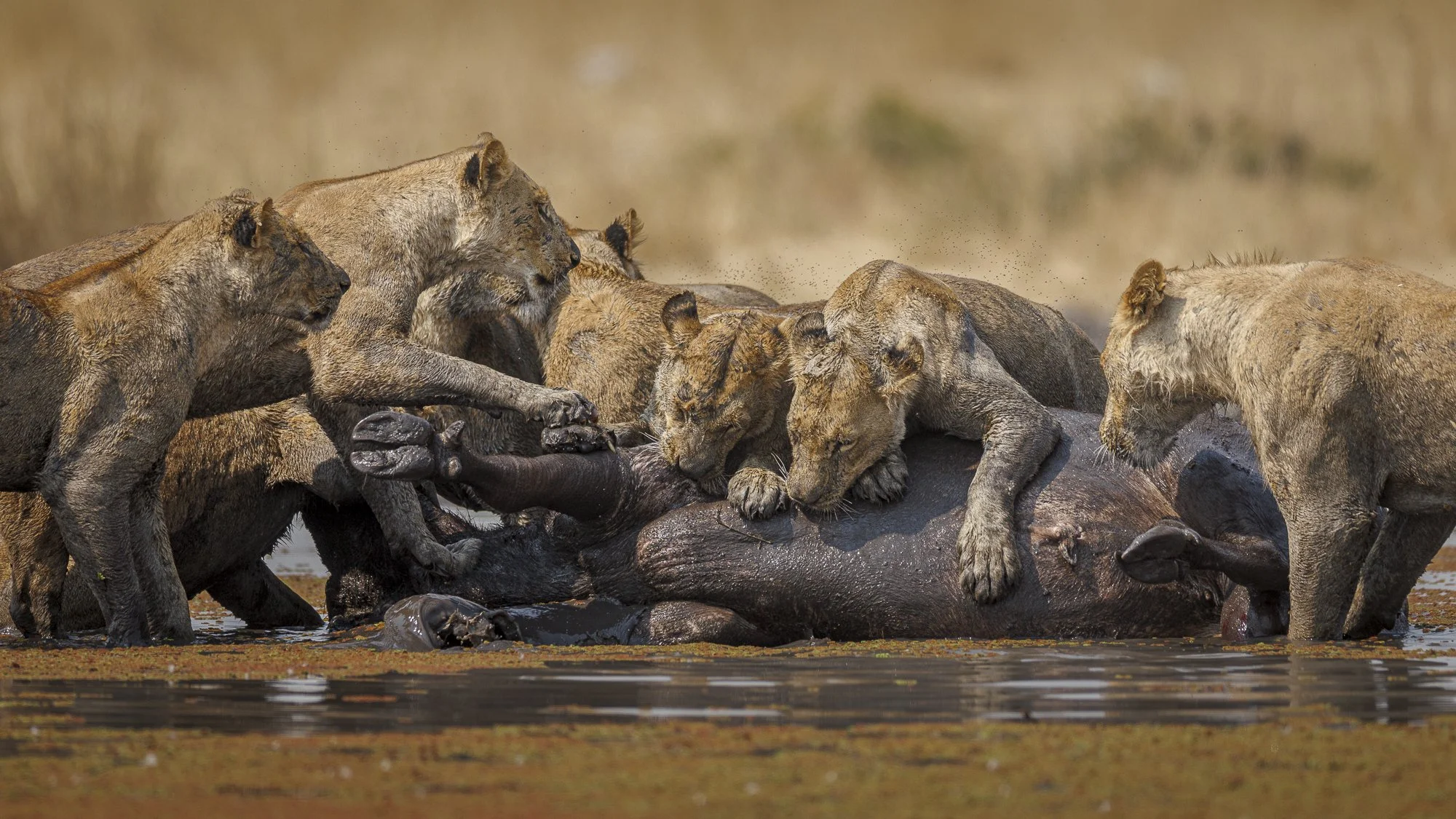
Image of lionesses on buffalo kill
The Killing Queens
Whilst in Mokete, one of Botswana’s newest safari destinations, I had spent most of time amongst the two resident lion prides in the private concession. I had seen a few lion hunts from start to finish during my time there, but this kill by the eight lionesses from the Chobe Pride was strategically flawless in its execution. And it happened at 2pm in the afternoon in 30 degree heat.
As we were driving around at the waters edge we noticed a small group of about 20 buffalo. We had heard that lionesses from the pride were in the vicinity, and as they had a fearsome hunting reputation, we thought that something might happen.
We spotted two of the lionesses hiding themselves behind bushes. Then with binoculars located the others. They were spread out in a half circle around the buffalos, clearly aware of the Buffalo’s prescence.
It was then that one of the lionesses did something extraordinary. She stood on a termite mound to make herself visible to the buffalo. The buffalo could only really move in one direction as there was deeper water to the right of them. Unfortunately, several lions were to their left lying in wait. There was also lions behind them too. The lioness on the mound looked around her, seemingly checking everyone was in place and then made her move towards the buffalo. The buffalo scattered but right into the other 7 lionesses. It took about 5 minutes for them collectively taken down one of the buffalo. I was awe struck not only at the power of these lionesses but also their intelligent hunting strategy as they made their kill.
Settings: Canon R5 II, EF 400 f2.8 III, 1/3200, F2.8, ISO 200
Thanks to Russell MacLaughlin whilst on location in Mokete, Botswana
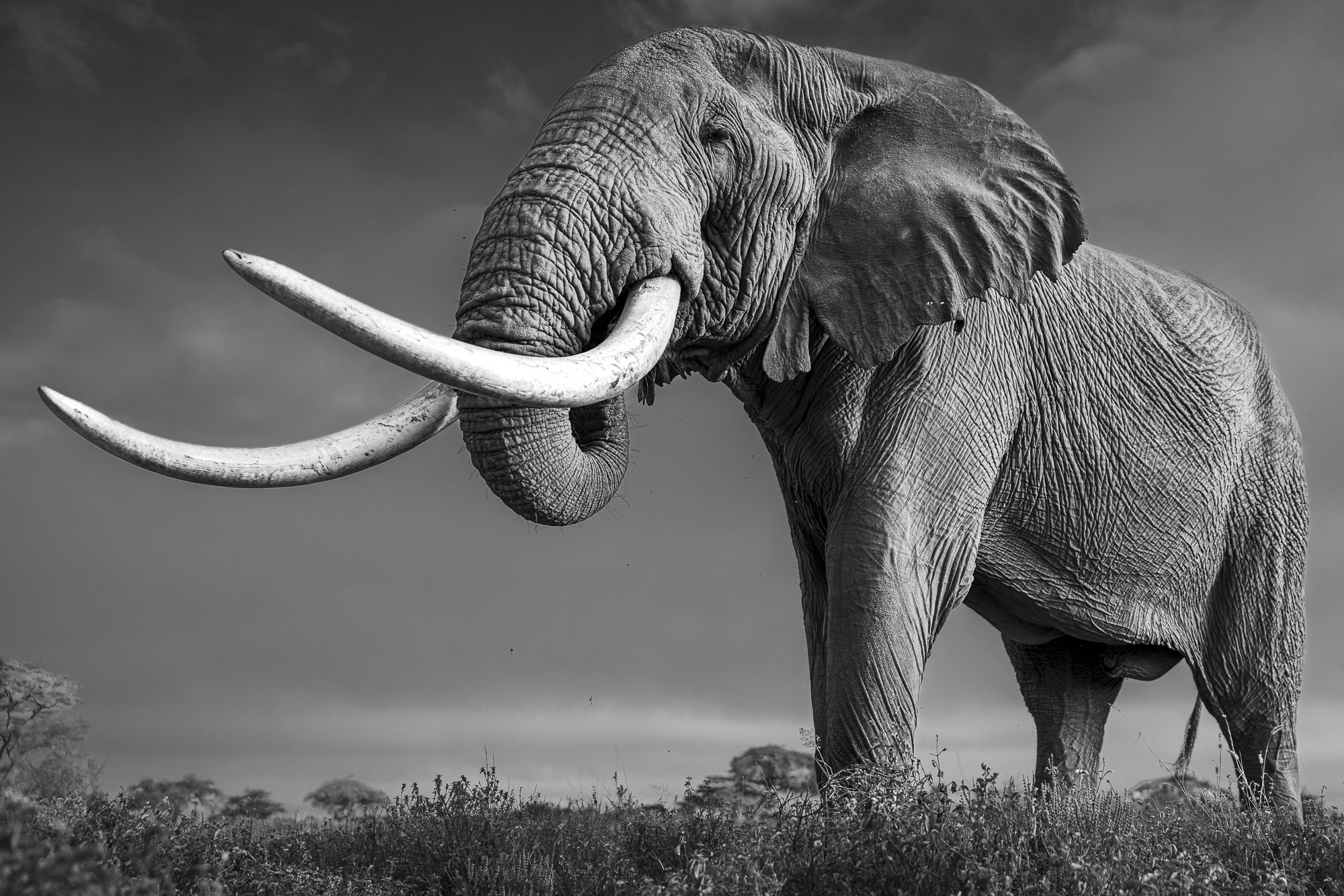
Portrait of Supertusker Vronsky
Vronsky
I have spent more time with Vronsky than any other elephant in Amboseli over the last few years. He’s magnificent and yet gentle elephant, who I’ve seen at his weakest during the terrible drought in East Africa in 2022, when thousands of elephants perished. He’s now over 50 and shown incredible resilience over the last few years, even being darted due to a leg injury.
In this image I was able to make full use of the specially designed photography vehicle and the fact that Vronsky was in a more elevated position to capture an image that emphasizes not only his impressive size but also his long-curved tusks, each likely weighing 45kg.
Vronsky is such a special an elephant & one I will always want to seek out whilst he roams the plains of Amboseli.
Settings: Canon R5, RF24-70mm F2.8, 1/1250, F2.8, ISO 100
Thanks to my guide Eric Ole Kalama and the team at Elephant Garden Camp
Many thanks for reading my photo story on what has been an amazing year. If you are interested in any of these images as limited edition prints please contact me directly here.
Wishing you a very happy New Year and!
Jules

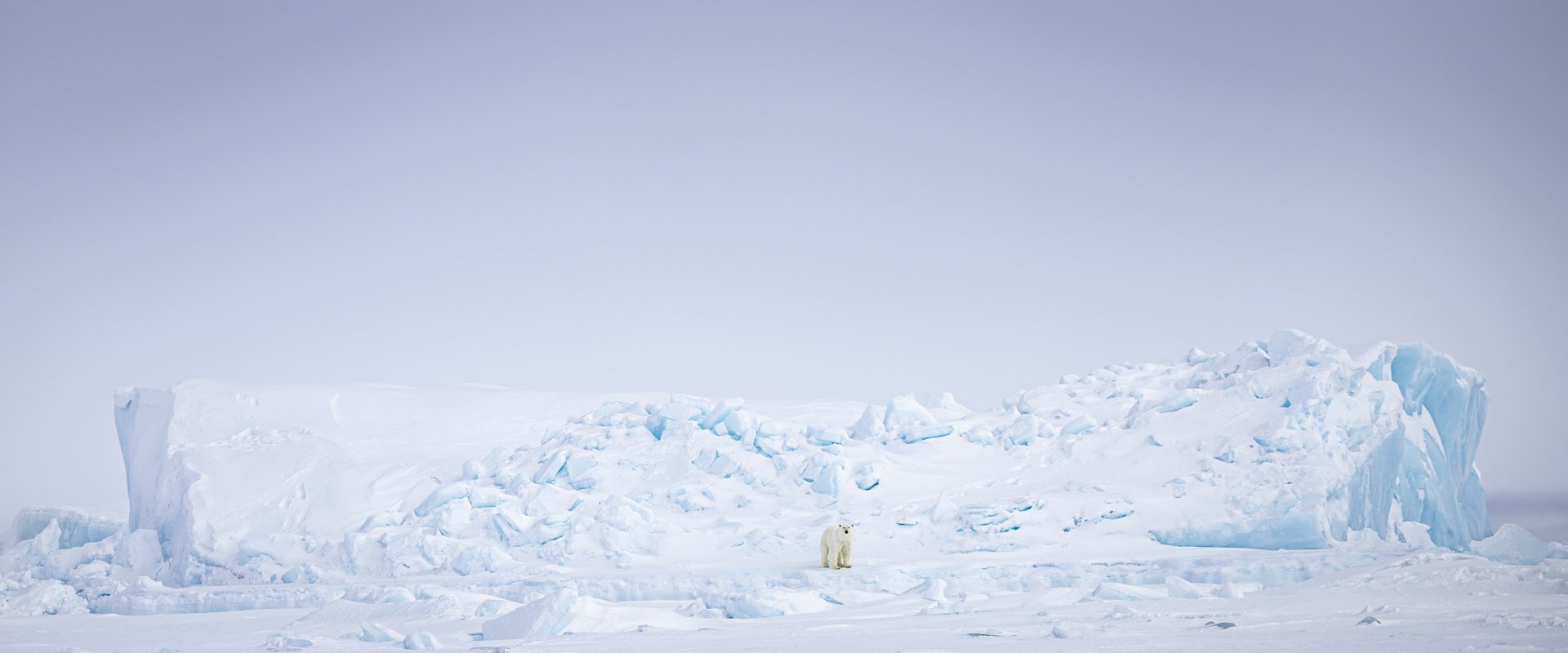
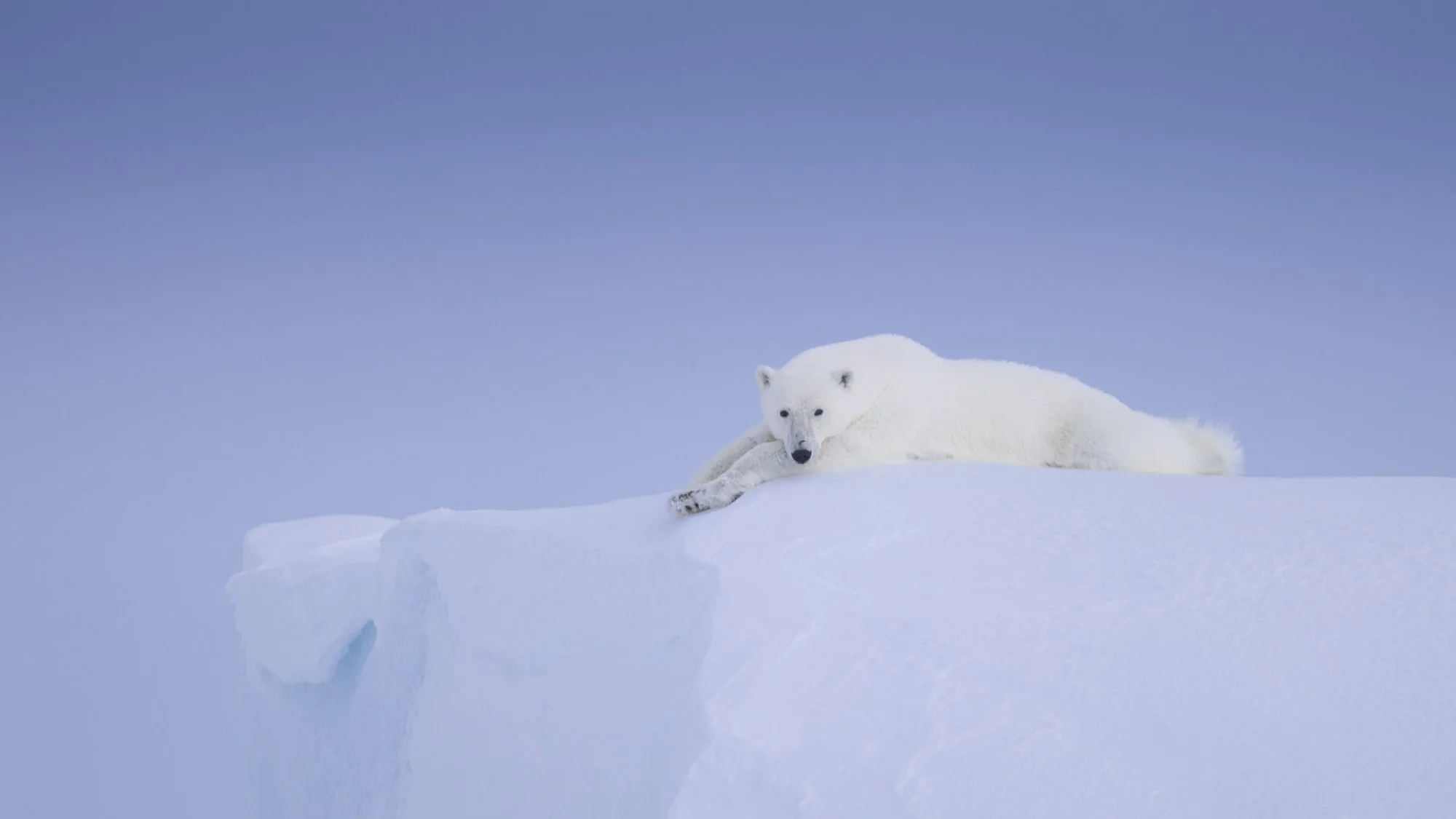
Svalbard, 2009
This was my first sighting of a polar bear taken nearly 20 years ago and I couldn't have asked for a more epic Arctic vista for my first encounter in Svalbard.
✓ Museum archival giclée paper
✓ Hand-signed & numbered by Jules
✓ Certificate of authenticity
✓ 15% to conservation
✓ Worldwide shipping
✓ Free UK delivery
The Full Story Behind The Photo
This was my first sighting of a polar bear taken in Svalbard nearly 20 years ago, yet I still remember it vividly. The excitement onboard our icebreaker the Vavivlov was palpable, especially as the scene itself was so breathtaking. The polar bear looked tiny as it walked along the shoreline framed by the towering glaciers. I couldn’t have asked for a more epic Arctic vista for my first Polar Bear encounter. I’ve had closer sightings of bears in Svalbard, but this image holds a special place for me as one of my favourite “animal in environment” images and reflects why it is so important to not only protect polar bears but also this pristine Arctic environment.
Print Specification
All prints are printed on Canson® Infinity Rag Photographique which is a 100% cotton museum grade white Fine Art and photo paper.
Canson® Infinity Rag Photographique offers a unique extra smooth surface with a sensual feel. It has been developed to address the need for continued longevity requirements in the Digital Fine Art market.
Shipping & Delivery
Delivery is from the United Kingdom and is included free with the purchase of all prints. Delivery is by FedEx, DHL, UPS, or DPD depending on location. Once your order is shipped you will receive an email with your tracking number. Please allow up to two weeks to fulfil your order plus one week for delivery.
Conservation Impact
As with all images in the collections, 15% of the proceeds from each image will be split between four charities- Kicheche Community Trust, Great Plains Foundation, Big Cat Initiative & Sheldrick Wildlife Trust. Learn more about giving back, here.